The Wartime History of Turnberry Airfield
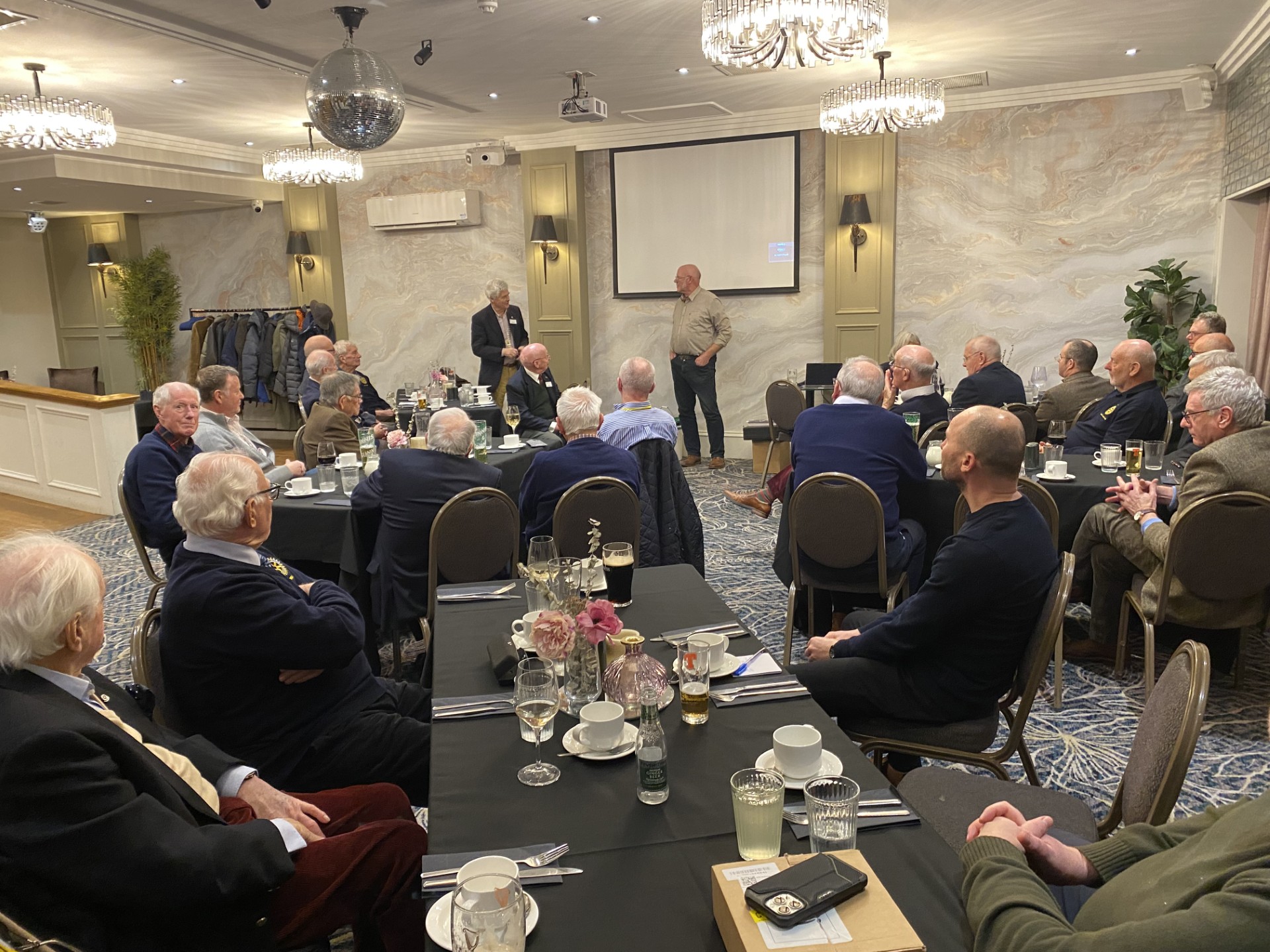
Tony speaking to a packed meeting room in Stravaig
We were treated to an excellent talk by guest speaker Tony Morrell on the history of Turnberry aerodrome. Here was the husband of the late Margaret who evidently had all the important facts at her fingertips having spent much of her adult life engaged in meticulous research to uncover the many untold stories of this important military base.
Tony told us how the coming of the railway age had originally opened the Turnberry area to different potential uses. In the early 1900’s the entire area was requisitioned by the Royal Flying Corps to establish No.1 School of Aerial Fighting (Loch Doon, to the east, was used for a School of Aerial Gunnery) eventually becoming No.1 Fighting School (North-West Area). It provided pilots with three-week courses in the arts of aerial gunnery and combat, before being disbanded in 1919. The aerodrome was put to military use again during the second world war, this time by the RAF.
Tony referred often to his wife’s book Turnberry Airfield, demonstrating indepth knowledge of the aircraft and the men who flew (and frequently died) in them. He took us first of all through the various types of plane which had been in service at the base from the WW1 Bristol M1C monoplane fighter to the WW2 Handley Page night-time bomber. Then he turned his attention to the airmen themselves and told stories, many of which were previously untold before her own discoveries. The aerodrome complex, and nearby Maidens, housed up to 7000 airmen at one time and accidents were not uncommon. The stone memorial erected by the people of Kirkoswald parish on the Ailsa golf course in 1923 lists the RFC men killed during WW1.
Through Margaret’s investigative research, in November 1990, four sections were added to the base of the memorial bearing the names of those who died at Turnberry during the Second World War. Many of those named on the memorial are buried at Dunure/Fisherton Cemetery and one American Airman who died in the First World War is buried in Doune Cemetery, Girvan.
Justifiably it is Margaret Morrell who has been credited with the addition of 80 men who were killed but whose names do not initially appear on the memorial.
Tony concluded with a quote from Sir Winston Churchill
“Writing a book is an adventure. To begin with it is a toy and an amusement. Then it becomes a mistress, then it becomes a master, then it becomes a tyrant. The last phase is that just as you are about to be reconciled to your servitude, you kill the monster and fling him to the public.”
Brian Hignett gave a worthy vote of thanks.